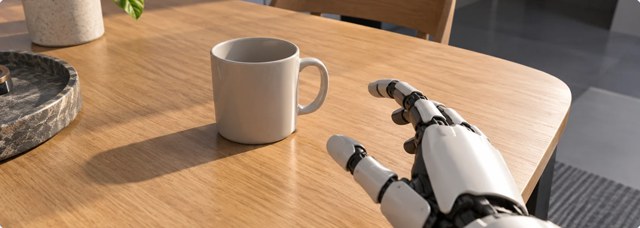
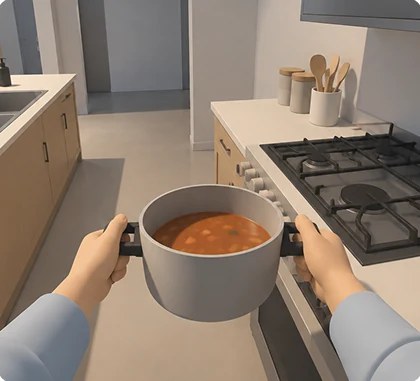
Tens of thousands of proprietary 3D, Gaussian splat and 360° worlds, in the physical and the virtual world, captured at scale with objects. VLGE has a network of spatial captures.
The Future of Physical AI Will Be Shaped by Human Experience
VLGE is a spatial and human intelligence platform that captures, generates, and scales real-world environments and human behavior to train, evaluate, and deploy intelligent agents. Combining photorealistic 3D digital twins, multimodal human sensory and action data, and a proprietary simulation engine, VLGE transforms physical environments and human experiences into structured, AI-ready datasets. Its agentic systems expand these datasets through synthetic interactions and controlled scenario variations, while human-grounded benchmarks measure how intelligently agents perceive, navigate, interact with, and respond to the world. This unified infrastructure powers world models, robotics, and agentic AI, while enabling enterprises across retail, real estate, hospitality, and entertainment to simulate, design, and optimize physical and digital environments.
Real estatePhotorealistic digital twins, spatial measurements, interactive layouts, environmental design, guest interaction intelligence, human behavioral intelligence
01
Human Behavior in Simulation
Within these worlds, we capture synthetic human behavior: interaction, exploration, kinematics, and manipulation.
3Mhours of build data
4M+hours of play data
164Kdatapoints / hr · play + edit
captured with consent · GDPR-compliant · and counting
Data points
3D environments
3DGS
Spatial metadata
Event streams
Physics
Hands & fingers
Joint, arm & reach
Interaction events
Behavioral layer
VLA task layer
Perception exports
Multi-agent capture
Physics-based motion
Spatial sensor (LiDAR)
Object properties
RGB
Depth
Segmentation
State
Mass
Friction
Material class
02
Agents
We generate synthetic manipulation data with LLM-based agentic AI. VLGE’s agents learn from human behavior and produce new rollouts across tasks and conditions.
01
Human play trains the agent
run 1run 2run 3run 4run 5run 6
02
The agent scales the synthetic data
scales ×N · re-runs, keeps human-like data
HumanAgent
03
The agent generates the long tail
03
Real-World Human Sentiment and Expertise
VLGE captures real-world human behavior, from everyday tasks to domain expertise.
Instrument the person, task and environment.
01
Experts in different domains
Retail · Museum · Hospitality · Sports · Robotics
02
Skill-specific derived signals
Domain-specific
03
Transfer skills from expert to agents
Human reference · agent
What the capture produces · shared capture schema · 415 fields
Vision
Ego RGB / depth
World RGB-D / video
Kinematics
Body joints
Hand / finger joints
Physiology
EMG channels
EEG channels
Heart rate / EDA
Context
Gaze
Audio
Object state
Task state
Action data
Approach
Reach & grasp
Pick up & inspect
Compare options
Hesitation
View & orient
Adjust lighting
Kick / contact
Environment-conditioned data
Light level
Temperature
Layout & displays
Spatial mapping
Shared extracted features
Trajectory smoothness
Speed profile
Dwell time
Action frequency
04
VLGE 3D Engine
Scaling real-world data using VLGE’s 3D engine.
Once a task exists in the engine, we can systematically vary the world state (object pose, layout, geometry, obstacles, initial conditions) and collect human behavior across those controlled variations without rebuilding a new physical setup each time.
01
One demonstration in the real world
Cameras and markers track the person and the object
02
In VLGE’s 3D engine, the world state is systematically varied
A broader range of behavior, and a benchmark that generalizes beyond one fixed scene
05
Benchmark
We collect real and synthetic human behavior data to train AI agents, test their performance on the same tasks, and prepare them for real-world deployment in robots.
We find exactly in which aspects the agent is failing, and improve it.
The Human Reference
Many people in the same scenario. Trajectory, hesitation, decisions, attention.
The Agent
Run many times in the same scenario, measured on the same signals.
Behavior Comparison
Compare how the agent behaves with how people behave, signal by signal.
Human · noise floorAgentExpert · ceiling
The human-to-human floor tells us whether the agent falls inside or outside natural human variation. A distance has no upper bound: it tells you the agent is wrong, not how wrong. So we add a second reference population: experts. Now the distance becomes a position, for example thirty percent of the way from a novice to an expert, and because the score is decomposed by behavior, it shows what is still missing.
Our mission is to ensure people remain the architects of their own minds by making real human behavior the anchor of AI training, simulation, and evaluation.